

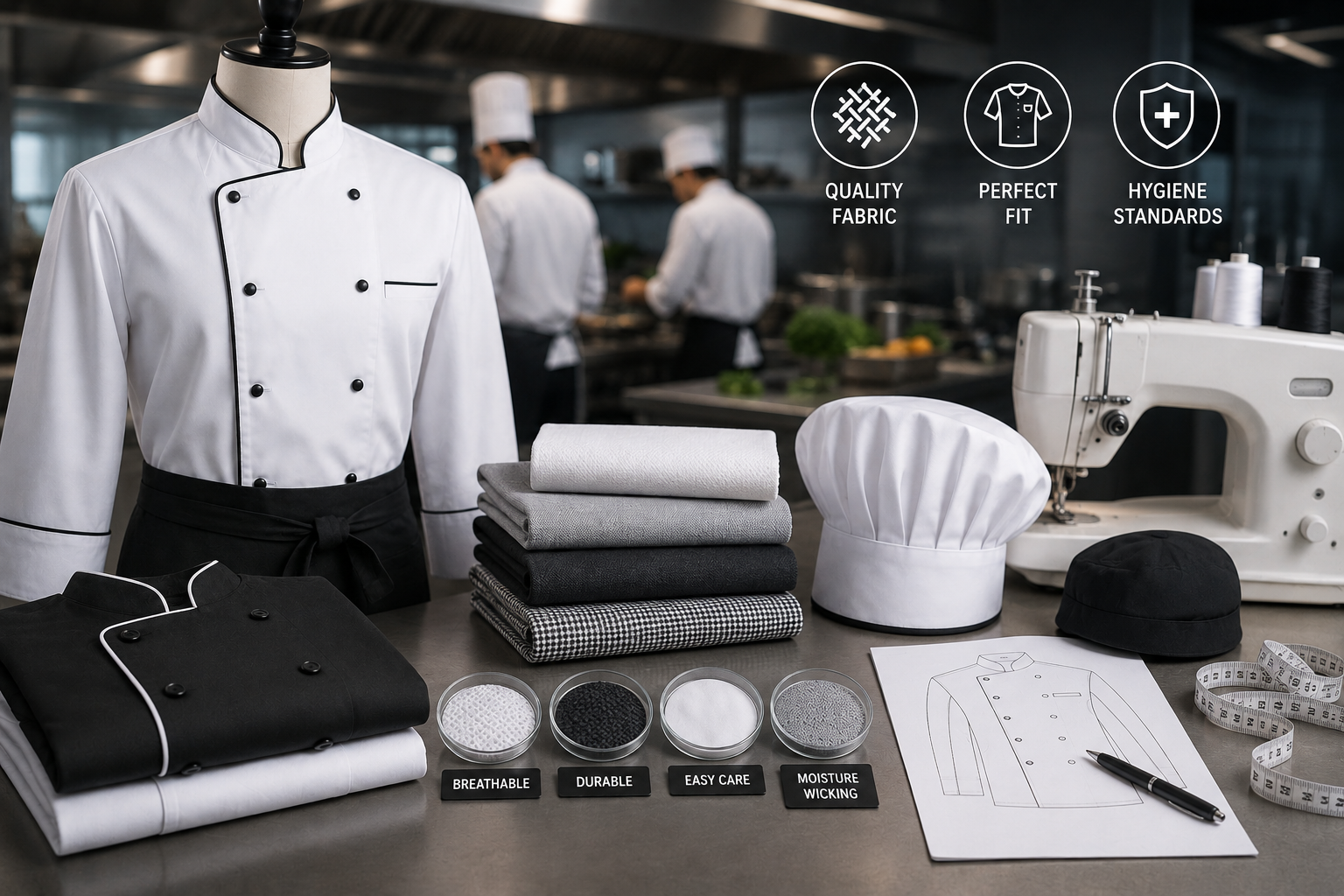
Chef Uniform Manufacturing: Fabric, Fit & Hygiene Standards
A chef’s uniform isn’t just a “look.” It’s PPE, a hygiene barrier, and a brand statement wearing three hats at once (pun intended). Get the fabric or fit wrong, and you’re either dealing with burnt sleeves or an FSSAI inspector shaking their head.
This guide breaks down exactly what goes into professional chef uniform manufacturing — from GSM and fabric blends to the hygiene rules every commercial kitchen in India needs to follow, and how to choose the right partner among the many clothing manufacturers in India.
What Fabric Is Best for Chef Uniforms?
A 65% polyester–35% cotton blend, in 180–220 GSM, is the industry standard. It balances breathability, stain resistance, and durability against heat and repeated washing.
Pure cotton is comfortable and breathable, but it wrinkles fast and starts fading after around 20 washes. Pure polyester is tough and dries quickly, but it doesn’t breathe well in a kitchen that regularly hits 100°F (38°C) near the stoves.
That’s why most professional kitchens land on a blend. The poly-cotton mix gives chefs a coat that survives 50 to 80 industrial wash cycles, resists wrinkling without constant ironing, and still lets sweat evaporate during a 10-hour shift.
GSM (grams per square meter) matters more than people realize. Anything below 160 GSM feels light but stains and thins out quickly. Anything above 240 GSM turns stiff and restricts movement at the stove. The 180–220 GSM range is the sweet spot — thick enough to guard against hot oil splashes, light enough to move in.
For high-heat sections like the tandoor or grill station, flame-resistant treated fabric is worth the extra cost. It won’t make a chef fireproof, but it buys precious extra seconds if there’s a flare-up.
Why Do Chef Uniforms Have to Meet Hygiene Standards?
Because in India, it’s not optional — it’s regulation. FSSAI (Food Safety and Standards Authority of India) guidelines require every food handler to wear clean, hygienic protective clothing, cover their head, and avoid jewellery on the job.
This isn’t bureaucratic box-ticking. Dirty or damaged uniforms are a direct contamination risk, and FSSAI treats it seriously enough to tie it to licence compliance.
Here’s what the guidelines actually require on the ground:
- Clean uniforms or aprons, worn fresh each shift
- Hair nets or chef caps to stop stray hair from ending up in food
- No jewellery, since rings and bracelets harbour bacteria
- No street shoes inside food prep areas
- Uniforms free of holes, rips, loose buttons, or visible dirt
Inspectors also check something manufacturers can directly influence: garment durability. A uniform with buttons that pop off after ten washes isn’t just annoying, it’s a hygiene liability sitting on a kitchen floor.
There’s a workforce angle too. FSSAI mandates at least one certified Food Safety Supervisor for every 25 food handlers, and staff undergo annual medical checks. A well-made uniform is one less thing for that supervisor to flag during a walkthrough.
What Makes a Chef Uniform Fit Properly?
A good chef uniform fits close enough to avoid loose fabric near flames, but loose enough for full arm and shoulder movement at the station. Fit failures usually show up in three places: sleeves, collar, and length.
Sleeves that are too long are a genuine safety issue near open flames and hot oil — they’re one of the more common causes of kitchen fabric burns. Fold-back cuffs, standard on most professional chef coats, let staff adjust length on the spot.
The double-breasted front isn’t just tradition. It lets a chef flip the jacket to hide stains mid-shift for front-of-house moments, and the extra fabric layer adds a bit more heat and splash protection across the chest.
Collar design matters more than most buyers expect. A stand-up collar with a stiff inner layer protects the neck from steam and splatter, while a soft collar is more comfortable for prep and pastry stations with less direct heat exposure.
Sizing consistency across a bulk order is where a lot of buyers get burned (sorry). If your XL from batch one fits differently than your XL from batch three, that’s a manufacturing quality problem, not a sizing chart problem. This is exactly why working with an experienced manufacturer with a proper quality control process matters more than picking whoever quotes the lowest price.
How Should You Choose a Chef Uniform Manufacturer?
Look for three things: a documented quality control process, experience with food-service fabrics specifically, and the flexibility to customise for your brand. Price matters last, not first.
India remains one of the strongest sourcing bases globally for this — the country’s textile and apparel industry contributes close to 2% of GDP and around 11% of manufacturing GVA, employing over 45 million people, according to IBEF. That scale means serious manufacturing capability, but it also means the market is crowded with options of wildly different quality.
A few practical filters to apply when comparing clothing manufacturers in India:
Ask about their QC process. A serious manufacturer inspects fabric at sourcing, checks stitching before and after sewing, and does a final inspection before packaging — not just a glance before shipping.
Ask if they’ve made food-service garments before. Chef coats, aprons, and kitchen uniforms have different stress points than casual shirts. A manufacturer used to producing formal or casualwear may not know why fold-back cuffs or reinforced underarm vents matter.
Ask about MOQs and customisation. Hotels and restaurant chains need consistent branding — logo embroidery, colour-coded uniforms by department, size runs that match their actual staff. A rigid manufacturer with fixed templates won’t flex for that.
Ask where they’re based and whether that’s convenient for you. Searching “clothing manufacturers near me” makes sense if you want easier sampling visits and faster communication, but don’t rule out manufacturers in established textile hubs like Rajasthan or Tamil Nadu just because they’re not local — many ship samples and manage the entire process remotely with structured production timelines.
What Does the Chef Uniform Manufacturing Process Actually Look Like?
It runs through roughly six stages: fabric sourcing, pattern making, sampling, bulk production, quality checks, and packaging with your branding. Each stage has its own failure points worth watching.
Fabric sourcing sets the ceiling for everything else — a manufacturer cutting corners on GSM or blend ratio here can’t fix it later with good stitching. Pattern making and sampling is where fit gets locked in, so this is the stage worth the most back-and-forth before approving bulk production.
Quality control should happen at multiple checkpoints, not just at the end. A good process checks the grey fabric, checks after cutting, checks after sewing, and does a final inspection with something as simple as a tolerance check on measurements (typically within 1 to 1.5 cm) before anything gets boxed.
Packaging matters more than buyers expect. Uniforms delivered “ready to wear” with your labels, size tags, and clean poly-bag packing save your operations team real time versus receiving loose garments that need sorting and labelling in-house.
FAQs
Q: How often should chef uniforms be replaced?
Most poly-cotton chef coats hold up for 50 to 80 industrial wash cycles before fabric quality noticeably declines — for a kitchen washing daily, that’s typically a 6 to 12 month replacement cycle.
Q: Is 100% cotton or a poly-cotton blend better for chef coats?
Poly-cotton blends are generally the better choice for commercial kitchens. Pure cotton is more breathable but wrinkles and fades faster; the blend holds up to frequent industrial washing while staying reasonably breathable.
Q: What GSM should I look for in chef uniform fabric?
180–220 GSM is the standard range for chef coats — enough weight for splash and heat protection without becoming stiff or heavy to work in.
Q: Are chef uniforms legally required to meet hygiene standards in India?
Yes. FSSAI guidelines require food handlers to wear clean, hygienic protective clothing, cover their hair, and avoid jewellery. Non-compliance can affect a food business’s FSSAI licence status.
Q: What should I check before choosing a clothing manufacturer for bulk chef uniforms?
Check their quality control process, prior experience with food-service or workwear garments, sample consistency, and whether they offer custom branding — labels, tags, and colour-coding for different kitchen roles.
Leave a Reply