

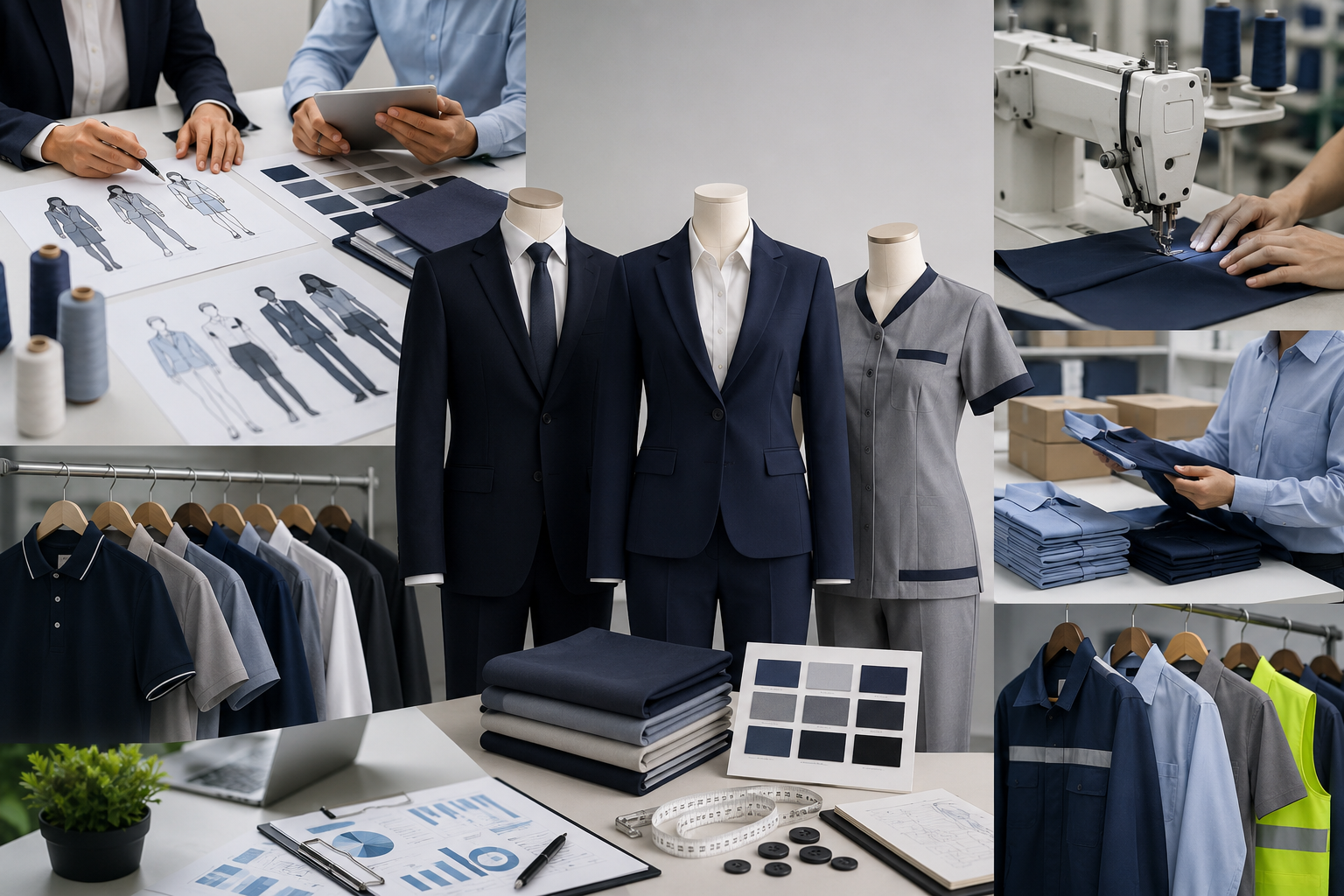
Corporate Uniform Manufacturing: A Complete Guide for HR & Procurement Teams
For HR managers and procurement teams, sourcing corporate uniforms is rarely as simple as placing an order and waiting for boxes to arrive. It’s a project that touches brand identity, employee comfort, budget planning, and long-term vendor reliability. A poorly chosen uniform program can lead to inconsistent sizing, fading colors, delayed deliveries, and frustrated employees while a well-managed one strengthens brand image and boosts team morale.
At Curves & Hems, we’ve worked with HR and procurement professionals across industries hospitality, healthcare, retail, corporate offices, and manufacturing to build uniform programs that are practical, professional, and cost-effective. This guide walks you through everything you need to know before you sign a contract with any uniform manufacturer, whether you’re outfitting 20 employees or 2,000.
Why Corporate Uniforms Matter More Than You Think
Uniforms aren’t just clothing they’re a business tool. Here’s what a well-designed uniform program delivers:
- Brand consistency: Every employee becomes a walking representation of your company identity.
- Professionalism: Clients and customers form quicker trust when staff look organized and uniform.
- Employee equality: Uniforms reduce visible income or style disparities among staff.
- Safety and compliance: In many industries, uniforms double as protective or identifiable workwear.
- Cost savings for employees: Staff don’t need to invest in “work-appropriate” wardrobes separately.
Given these stakes, choosing the right manufacturing partner is a decision that deserves real diligence — not a last-minute vendor pick.
Step 1: Define Your Uniform Requirements Before You Search
Before reaching out to any wholesale uniforms suppliers, get internal clarity on:
- Departments and roles — Front-office staff, warehouse workers, delivery teams, and executives often need different uniform types.
- Quantity and growth projection — Order volumes affect wholesale pricing tiers significantly.
- Fabric needs — Breathable cotton blends for hot climates, poly-cotton for durability, or moisture-wicking fabric for physically active roles.
- Branding elements — Logo embroidery, company colors, name tags, or woven labels.
- Budget per unit — Factor in shirts, trousers, jackets, aprons, or seasonal variations separately.
- Timeline — Build in buffer time for sampling, approval cycles, and bulk production.
Having this brief ready before contacting suppliers saves weeks of back-and-forth and helps you get accurate quotes faster.
Step 2: Choosing the Right Uniform Manufacturer
Not every uniform manufacturer is equipped to handle corporate-scale orders with consistency. Here’s what separates a dependable manufacturing partner from a risky one.
Production Capacity and Consistency
A reliable manufacturer should be able to replicate the exact same fit, color, and fabric quality across hundreds or thousands of units batch after batch. Ask for references from other corporate clients of similar order size.
In-House vs. Outsourced Production
Manufacturers that control cutting, stitching, and finishing in-house typically offer better quality control and faster turnaround than those outsourcing to multiple third-party units.
Fabric Sourcing Transparency
A trustworthy uniform manufacturer will clearly disclose fabric composition, GSM (fabric weight), and sourcing important for durability claims and any sustainability commitments your company has made.
Customization Capabilities
Look for manufacturers offering embroidery, screen printing, heat-transfer branding, and made-to-measure sizing options, especially if your workforce has diverse body types.
Compliance and Certifications
For industries like healthcare, food service, or manufacturing, ensure the uniform manufacturer complies with relevant safety standards (flame-resistant fabrics, antimicrobial treatment, high-visibility requirements, etc.).
Step 3: Finding a Reliable “Uniform Supplier Near Me”
Many procurement teams search for a “uniform supplier near me” assuming proximity guarantees faster service — but location is only one piece of the puzzle. Here’s how to evaluate local and regional options properly:
- Sample turnaround time: A nearby supplier should be able to deliver physical samples within days, not weeks.
- On-site visits: Proximity is valuable if you want to inspect production facilities or fabric quality in person before committing to a bulk order.
- After-sales support: Local suppliers are often easier to reach for reordering, size exchanges, or replacements.
- Logistics costs: Local sourcing can meaningfully reduce shipping costs and delivery timelines for recurring bulk orders.
That said, don’t sacrifice quality or customization capability purely for convenience. A manufacturer slightly farther away with better production standards, digital sampling, and reliable logistics will usually outperform a local option that can’t scale with your needs.
Step 4: Sizing and Fit Management for Large Teams
One of the biggest pain points HR teams report is sizing inconsistency across bulk orders. To avoid this:
- Request a size chart and fit sample before finalizing your order.
- Run an internal sizing survey across departments before placing the bulk order.
- Ask your manufacturer if they support size-run flexibility (ability to reorder specific sizes without re-ordering the full batch).
- For diverse or larger workforces, confirm whether the manufacturer offers inclusive sizing ranges rather than standard S–XL only.
Step 5: Budgeting and Negotiating with Manufacturers
Procurement teams should factor in more than just the per-unit price:
- Minimum Order Quantities (MOQs) — Understand tiered pricing based on volume.
- Sample costs — Some manufacturers charge for pre-production samples; factor this into your budget.
- Rebranding costs — If your company rebrands, will the manufacturer accommodate design updates without major repricing?
- Replacement policy — Ask about costs for lost, damaged, or new-hire uniform reorders after the initial bulk order.
- Payment terms — Larger, ongoing partnerships often unlock better payment flexibility (e.g., installments tied to production milestones).
Step 6: Building a Long-Term Uniform Partnership
The best outcomes come from treating your uniform manufacturer as a long-term partner, not a one-time vendor. Benefits of long-term partnerships include:
- Locked-in pricing as your order volume grows
- Faster turnaround on reorders since patterns and specs are already on file
- Priority production slots during peak seasons
- Easier design updates for rebranding or seasonal uniform refreshes
Why HR & Procurement Teams Choose Curves & Hems
At Curves & Hems, we specialize in end-to-end corporate uniform manufacturing from initial consultation and fabric selection to bulk production and nationwide delivery. As a dedicated uniform manufacturer, we support HR and procurement teams with:
- In-house cutting, stitching, and finishing for consistent quality across large orders
- Custom embroidery and branding options
- Flexible MOQs suited for growing businesses
- Transparent fabric sourcing and quality assurance
- Reliable timelines for both first-time bulk orders and recurring reorders
Whether you’re comparing wholesale uniforms suppliers for a quick basic order or searching for a uniform supplier near me for an ongoing corporate partnership, Curves & Hems is built to scale with your workforce.
Leave a Reply