

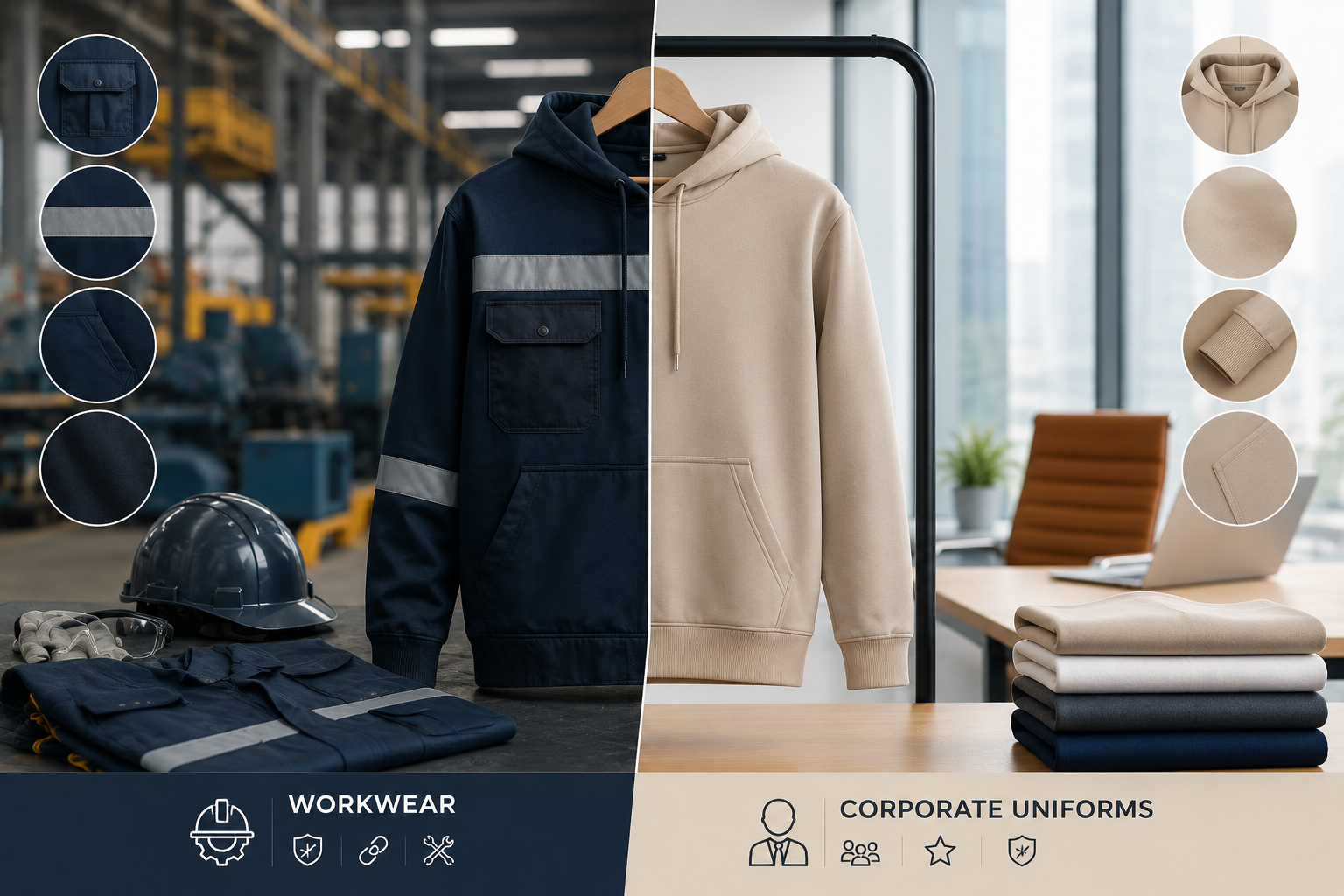
Workwear vs Corporate Uniforms: Key Differences Explained
Workwear and corporate uniforms both serve as branded, standardized clothing for employees, but they are built for different jobs. Workwear is engineered primarily for protection and durability in industrial, manual, or hazardous environments, while corporate uniforms are designed primarily for brand identity, professionalism, and customer-facing consistency in offices, retail, and hospitality settings. The two categories often overlap in fabric and manufacturing process, but they diverge sharply in fabric selection, compliance requirements, design priorities, and lifecycle costs. Understanding this distinction matters before you brief a manufacturer, because ordering the wrong category can mean paying for safety features you don’t need or, worse, missing safety features you do.
This guide breaks down exactly where workwear and corporate uniforms differ, where they overlap, and how to decide which one your business actually needs, or whether you need a hybrid of both.
What Is the Core Difference Between Workwear and Corporate Uniforms?
The core difference is purpose. Workwear exists to protect the wearer from workplace hazards — heat, flame, chemicals, abrasion, cold, moving machinery, or visibility risk. Corporate uniforms exist to project a consistent, professional brand image to customers, clients, and the public. Workwear is judged by how well it survives a shift on a factory floor or construction site. A corporate uniform is judged by how well it represents the company on a sales floor, in a boardroom, or at a hotel front desk.
This purpose gap shapes every downstream decision: fabric weight, stitching method, compliance certification, color palette, and even how often the garment gets replaced.
Do Workwear and Corporate Uniforms Have Different Compliance Requirements?
Yes. Workwear frequently falls under occupational safety regulations that corporate uniforms never touch. Depending on the industry and region, workwear may need to meet standards for flame resistance, high-visibility marking, chemical splash protection, or electrical arc resistance. This isn’t optional branding it’s a legal and liability requirement, and non-compliant workwear can expose a company to safety violations, insurance issues, or worker injury claims.
Corporate uniforms, by contrast, are rarely governed by safety standards. Their “compliance” is closer to brand guidelines approved color codes, logo placement rules, and dress code policy rather than government-mandated protective standards.
How Does Design Priority Differ Between the Two?
Workwear design starts with a hazard assessment: What can hurt this worker, and how does the garment prevent it? Pockets, reinforcement, and fit are engineered around specific tasks — a welder’s sleeve length, an electrician’s tool storage, a warehouse worker’s visibility needs.
Corporate uniform design starts with a brand assessment: What should this employee’s appearance communicate to a customer? Fit, color palette, and silhouette are engineered around brand identity — a hotel’s color scheme, a bank’s formality level, a retail chain’s approachability.
Which Industries Typically Need Workwear vs Corporate Uniforms?
- Workwear-driven industries: manufacturing, construction, warehousing and logistics, oil and gas, automotive service, electrical and utilities, food processing, agriculture
- Corporate uniform-driven industries: banking and finance, hospitality and hotels, retail and F&B, airlines and travel, corporate offices, healthcare front-desk and administrative staff
- Hybrid-need industries: healthcare (clinical scrubs need durability and hygiene compliance, but front-office staff need brand-forward uniforms), facilities management, aviation ground staff, field service technicians who also meet clients
Can a Business Need Both Workwear and Corporate Uniforms?
Yes, and this is common in mid-to-large organizations with multiple employee categories. A manufacturing company, for example, may need heavy-duty FR-rated workwear for shop-floor staff and separate tailored corporate uniforms for its sales and administrative teams. Working with a single manufacturer who can produce both — rather than splitting the order across two vendors — reduces lead time, keeps branding consistent across both lines, and simplifies quality control since one team owns fit, fabric sourcing, and delivery timelines.
How Does Cost and Lifecycle Compare?
Workwear generally carries a higher per-unit cost due to heavier fabric, reinforced construction, and any required certifications, but it also has a longer functional lifecycle in high-wear environments — it’s built to survive repeated abrasion, washing, and physical stress. Corporate uniforms are typically lower per-unit cost but may need more frequent replacement to maintain a polished, presentable appearance, since fading, pilling, or minor wear is more visible in a customer-facing role than on a factory floor.
When budgeting, it’s more accurate to compare cost-per-wear over the garment’s expected lifespan rather than comparing sticker price alone.
How Do You Decide Which One Your Business Needs?
Ask three questions before briefing a manufacturer:
- Is the employee exposed to a physical hazard? If yes, you need workwear that meets the relevant safety standard for that hazard — this isn’t negotiable on appearance grounds.
- Is the employee customer- or client-facing? If yes, brand consistency, fit, and appearance should lead the design brief.
- Does the role involve both? Field technicians, delivery staff in branded vehicles, and site supervisors often need a hybrid garment — protective enough for the task, branded enough to represent the company.
Frequently Asked Questions
Is workwear the same as a uniform?
No. All workwear can function as a uniform when it’s standardized and branded, but not all uniforms qualify as workwear. Workwear specifically implies a protective or task-driven function; uniform simply means standardized clothing for identification or branding purposes.
What GSM is best for industrial workwear?
Most industrial workwear performs best between 220 and 320 GSM, depending on the hazard level. Lighter-duty roles may use fabric closer to 220 GSM for breathability, while high-abrasion or high-hazard roles typically need 280 GSM or higher.
Do corporate uniforms need any safety certification?
Generally no, unless the role itself carries a specific risk — for example, kitchen staff needing flame-resistant aprons or lab-adjacent administrative staff needing specific fabric compliance. Standard office, retail, and hospitality uniforms don’t require safety certification.
Can one manufacturer produce both workwear and corporate uniforms?
Yes. Manufacturers with both industrial and tailoring capabilities can produce both categories under one order, which keeps branding consistent and simplifies vendor management for companies with multiple employee categories.
How often should workwear be replaced compared to corporate uniforms?
Workwear is typically replaced based on wear condition rather than a fixed schedule, since it’s built for durability — often 12 to 24 months in high-use environments. Corporate uniforms are often replaced on a set cycle, commonly annually, to maintain a consistently polished appearance.

Leave a Reply