

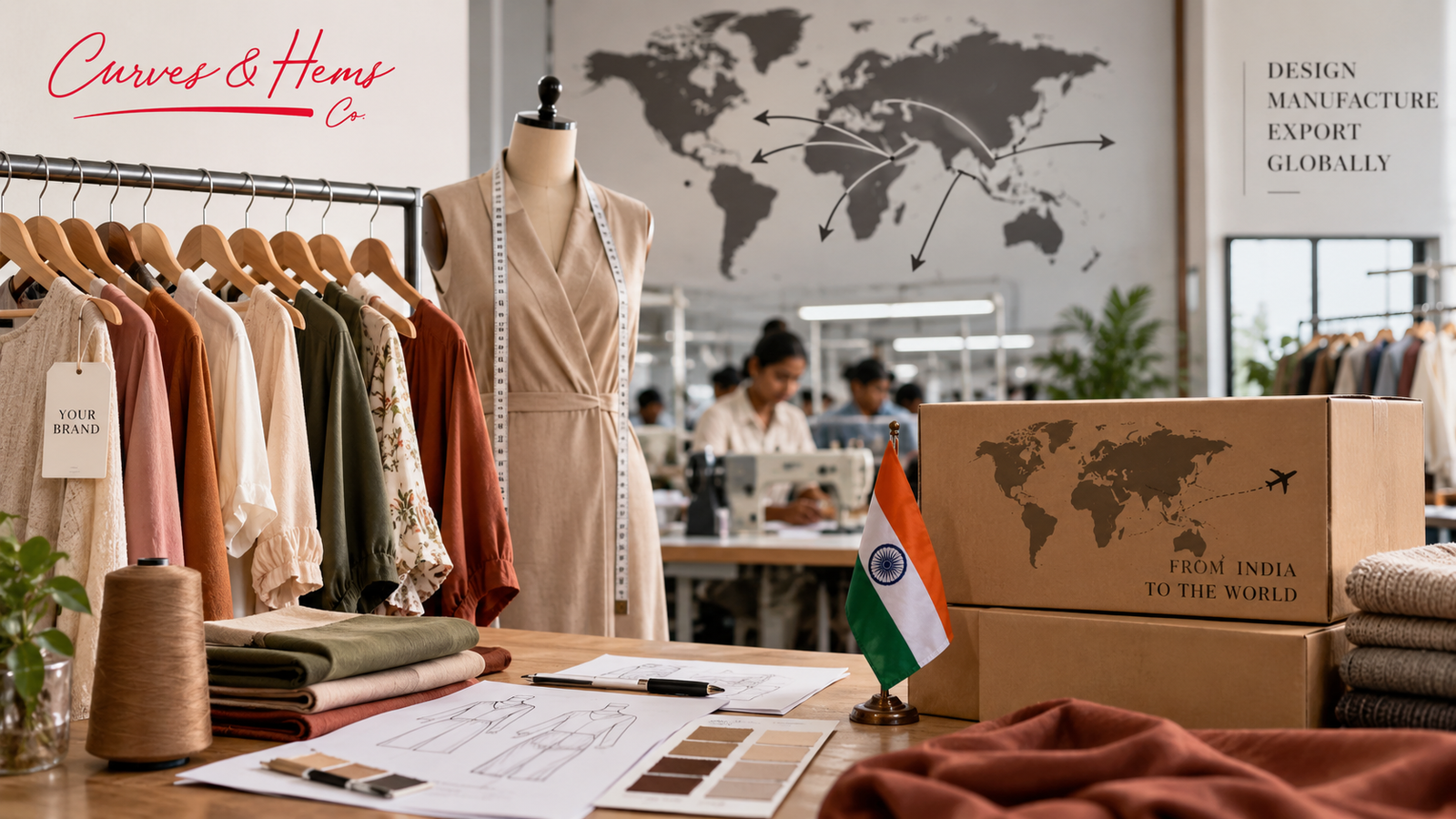
Best Private Label Clothing Exporters from India
The best private label clothing exporters from India are the ones with proven export documentation, internationally recognized certifications (OEKO-TEX, GOTS, BSCI/SEDEX), transparent FOB/CIF pricing, and a track record of shipping to markets like the US, UK, EU, and GCC — not just factories that claim “we export.” In over two decades of connecting international buyers with Indian garment factories, I’ve seen the same mistake repeated: brands choose an exporter based on price alone, only to discover mid-shipment that the factory has never actually cleared customs documentation for their destination country.
This guide is written for founders, sourcing managers, and retail buyers evaluating Indian clothing exporters for private label programs — what separates a genuinely export-ready manufacturer from a domestic factory that occasionally ships abroad.
What Does Private Label Export Manufacturing Mean?
Private label export manufacturing means an Indian factory produces garments to your specifications and ships them internationally under your brand name, with no factory branding attached. This differs from domestic private label work in one critical way: export orders require compliance with customs documentation, international labeling laws, and often third-party quality or social compliance audits that purely domestic manufacturers may never have handled.
Why Buyers Worldwide Source Private Label Clothing from India
India has built a decades-long reputation as a garment export hub, and for international private label buyers specifically, a few advantages stand out:
- Vertical fabric supply: Access to cotton, denim, and knit fabric production within the same country reduces lead-time dependency on third-party imports.
- Established export clusters: Tirupur (knitwear exports), Ludhiana (woolens), Jaipur and Ajmer (ethnic wear, private label, plus-size and uniform manufacturing), and Delhi NCR (fast fashion) each carry specialization that export buyers can match to their product category.
- Compliance infrastructure: A large and growing base of OEKO-TEX, GOTS, and BSCI/SEDEX-audited factories capable of meeting Western retailer compliance requirements.
- Competitive MOQs for export: Compared to fully bulk-only exporters in some Southeast Asian hubs, a segment of Indian exporters now accommodate smaller export test-orders for new private label brands.
How Do You Evaluate the Best Private Label Clothing Exporter for Your Brand?
Here’s the exact due-diligence checklist I recommend before any international buyer signs an export agreement:
- Export documentation experience: Ask for sample commercial invoices, packing lists, and certificates of origin from past shipments to your specific region.
- Certifications relevant to your market: OEKO-TEX for EU buyers, GOTS for organic-cotton programs, BSCI/SEDEX for retailers with social compliance requirements.
- Incoterms clarity: Confirm whether pricing is quoted FOB (Free on Board), CIF (Cost, Insurance, Freight), or EXW (Ex Works) — this changes your landed cost significantly.
- Sampling and pre-shipment inspection: Does the exporter support a pre-production sample (PPS) and a pre-shipment inspection (PSI) before the container is sealed?
- Communication across time zones: An exporter working with US or UK clients should have a workflow for async communication and clear order status updates — not five-day reply gaps.
- Category specialization: A strong exporter for basic knitwear may not be the right partner for plus-size grading or technical activewear — check their actual shipped portfolio, not just marketing claims.
What Certifications Should an Export-Ready Manufacturer Have?
For international private label buyers, certifications are often the fastest way to filter serious exporters from the rest:
- OEKO-TEX Standard 100: Confirms fabrics are tested for harmful substances — commonly requested by EU and UK retailers.
- GOTS (Global Organic Textile Standard): Required for brands marketing organic cotton or sustainable product lines.
- BSCI / SEDEX (SMETA): Social compliance audits covering labor practices, increasingly a requirement for large retail accounts and marketplaces.
- ISO 9001: General quality management certification, useful as a baseline indicator of process consistency.
This is where a manufacturer-exporter like Curves & Hems, based in Ajmer, positions itself for international private label buyers — combining export-oriented private label and OEM/ODM production across hoodies, t-shirts, uniforms, and inclusive plus-size garments, with compliance-ready documentation aimed at buyers who need more than just a domestic factory willing to ship a box overseas.
What Are Realistic MOQs for Export Orders from India?
Export MOQs are typically higher than domestic private label orders because of container and freight economics, but the range for 2026 looks roughly like this:
- Basic knitwear (t-shirts, hoodies): 300–500 pieces per style/color for a cost-efficient export shipment
- Wovens (shirts, uniforms): 300–1,000 pieces per style depending on fabric
- Full container load (FCL) orders: typically required for the most competitive per-unit freight cost, though LCL (less than container load) options exist for smaller test orders
New export buyers should always ask whether an exporter supports a smaller “trial shipment” via air freight or LCL sea freight before committing to a full container order.
How Much Does It Cost to Import Private Label Clothing from India?
Landed cost for export buyers includes more variables than domestic pricing:
- FOB unit price: Fabric, CMT (cutting, making, trimming), and factory margin
- Freight: Sea freight (economical, 20–40 day transit) vs air freight (faster, higher cost, used for smaller or urgent orders)
- Import duties and taxes: Vary by destination country and product HS code — always confirm with your customs broker before finalizing budgets
- Insurance and inspection costs: Especially relevant for CIF orders or when using third-party quality inspection services
Always request a full landed-cost breakdown rather than comparing FOB quotes alone — two exporters with similar unit prices can result in very different total costs once freight terms and duties are factored in.
Frequently Asked Questions
What is the difference between a manufacturer and an exporter in India?
A manufacturer produces garments, while an exporter handles the documentation, customs clearance, and international shipping process. Many Indian factories operate as manufacturer-exporters, handling both production and export logistics under one roof, which simplifies the process for international private label buyers.
Which Incoterm is best for a new private label buyer sourcing from India?
FOB (Free on Board) is generally recommended for buyers who want cost transparency and are comfortable arranging their own freight forwarder, while CIF (Cost, Insurance, Freight) suits buyers who prefer the exporter to handle shipping and insurance end-to-end.
Do Indian clothing exporters require large MOQs?
Export MOQs are typically higher than domestic orders due to freight economics, often starting around 300–500 pieces per style, though some exporters offer smaller trial shipments via air freight or LCL sea freight for new buyers.
How long does it take to export clothing from India?
Production typically takes 20–45 days depending on order size, followed by 20–40 days of sea freight transit time (or a few days via air freight), plus customs clearance time at the destination port.
What certifications should I look for in an Indian garment exporter?
Look for OEKO-TEX Standard 100 for fabric safety, GOTS for organic cotton claims, and BSCI or SEDEX (SMETA) for social compliance — the specific certification needed depends on your target market and retailer requirements.

Leave a Reply