
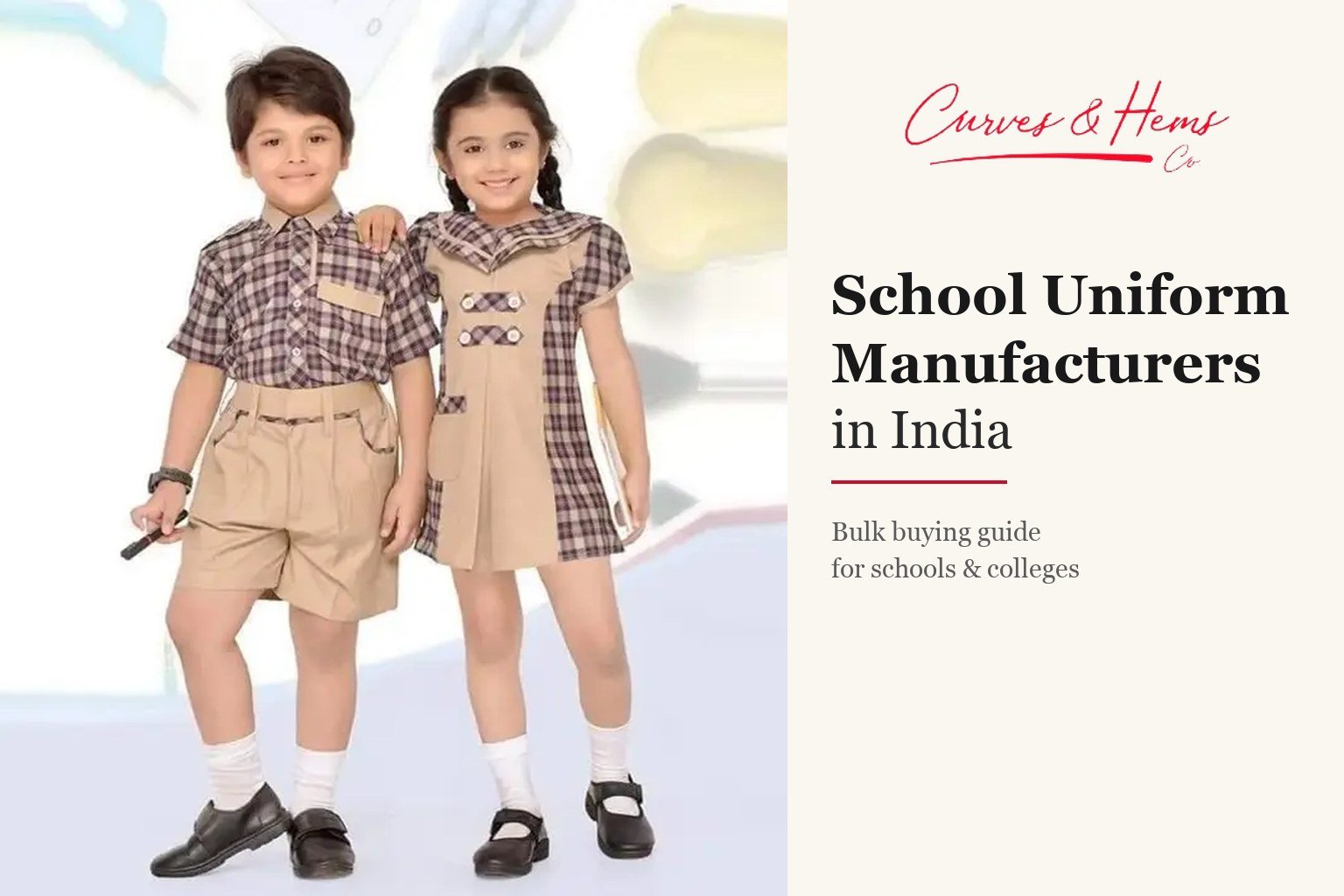
School Uniform Manufacturers in India: A Bulk Buying Guide for Schools
Quick answer: To order school uniforms in bulk in India, work directly with a manufacturer (not a trader), fix the fabric for each piece (poly-cotton for shirts, poly-viscose for trousers and skirts, pique knit for sports T-shirts), approve a sealed sample, and place the order 3–4 months before the new session. Curves & Hems, a uniform manufacturer in Ajmer, Rajasthan, makes custom school and college uniforms from 25 pieces per style on stock fabrics, with sampling before every bulk order.

Every April, thousands of schools across India face the same problem: uniforms that fade after a few washes, sizes that don’t match the chart, and deliveries that arrive after the session has already started. Most of these problems start with how the uniform was sourced, not how it was stitched.
This guide is for principals, school management committees, procurement heads and uniform vendors who want to buy school uniforms directly from a manufacturer. It covers fabrics, sizing, costs, timelines and the checks that separate a reliable supplier from a risky one.
What does a school uniform manufacturer do?
A school uniform manufacturer buys or sources the fabric, makes patterns, cuts and stitches the garments, adds the school logo (embroidery or print), checks quality and delivers the uniforms in bulk, either to the school or to an authorised uniform shop. A good manufacturer also keeps your exact fabric shade, pattern and logo on file so that next year’s order matches this year’s.
That last point matters more than most schools realise. If a parent buys a shirt in Class 3 and a replacement in Class 4, the two should look identical. Shade and size consistency across years is the clearest sign of a professional uniform supplier.
Manufacturer vs trader vs uniform shop: who should you buy from?
| Option | Price | Customisation | Consistency year to year | Best for |
|---|---|---|---|---|
| Direct manufacturer | Lowest per piece | Full: fabric, cut, logo, labels | High (patterns and shades kept on file) | Schools ordering 200+ sets, school groups, uniform vendors |
| Trader / agent | Medium (adds a margin) | Limited to what their factories offer | Varies, as factories may change | Very small or one-off orders |
| Local uniform shop | Highest | Mostly ready stock | Low | Individual parents |
If your school orders more than a few hundred sets a year, buying directly from the factory usually saves money and gives you control over quality. Many schools keep a local shop as the retail point but source from the manufacturer themselves.
Which fabric is best for school uniforms?
Children run, sit on the floor, spill food and wash their uniforms several times a week. The fabric has to survive that without fading, shrinking or pilling. Here is what works for each piece:
| Uniform piece | Recommended fabric | Why |
|---|---|---|
| Shirts and blouses | Poly-cotton (65/35 or 67/33) | Breathable, crease-resistant, holds white and pastel colours well |
| Trousers, skirts, pinafores | Poly-viscose (TR suiting) | Good drape, keeps pleats, resists wrinkles and wear at the knees |
| Sports / house T-shirts | Cotton or poly-cotton pique, 180–220 GSM | Absorbs sweat, keeps collar shape, prints and embroiders well |
| Track pants | Polyester knit or cotton-poly fleece | Stretch, durability and quick drying |
| Blazers | Poly-viscose or poly-wool blend suiting | Holds structure for formal events and winter wear |
| Summer uniforms (hot regions) | Higher cotton blends or 100% cotton | Comfort in Rajasthan, Gujarat and South Indian summers |
For a deeper comparison of cotton, poly-cotton and poly-viscose, read our guide on the best fabric for uniforms.
Tip: Ask the manufacturer to wash-test a sample before bulk production. A school uniform should not shrink more than about 3% or lose colour after repeated washing. Check checks and stripes especially, because cheap yarn-dyed fabric bleeds into white shirts.
What should a complete school uniform set include?
- Daily uniform: shirt or blouse, trousers, shorts, skirt or pinafore.
- Sports or house uniform: polo or round-neck T-shirt in house colours, track pants or shorts.
- Winter wear: blazer or jacket. (Knitted sweaters are usually sourced from specialist knitwear units.)
- Accessories: ties, belts, socks and badges. Most garment factories coordinate these through partners.
- Staff uniforms: many schools order matching uniforms for teachers, drivers and support staff at the same time. See our guide on corporate uniform manufacturing for staff wear.
How to choose a school uniform manufacturer in India: a 7-point checklist
- Do they manufacture in-house? Ask for factory photos or a video call of the production floor. Traders often present themselves as manufacturers.
- Will they make a sample first? A reliable supplier always makes a sample set for approval. What you approve should be exactly what you receive in bulk.
- Can they match your existing shade? If you are switching suppliers, send an old uniform so the new fabric matches it.
- What is the minimum order quantity (MOQ)? MOQs in the market range from 25 to 1,000+ pieces. Smaller schools need a supplier that accepts low quantities per style.
- How do they handle sizing? They should work from a proper size chart (by age and chest or waist) and pack by size and class.
- What is the logo method? Embroidered logos last the longest on blazers and pockets. Screen print or heat transfer suits sports T-shirts.
- Can they repeat the order next year? Ask how long they keep patterns, fabric references and logo files.
School uniform sizing: how to avoid the biggest headache
Wrong sizes cause more complaints than any other issue. Follow these steps:
- Use a size chart by measurement, not just by age. Children of the same age can differ by two sizes. Our guide on how to create a size chart for clothing explains how to build one.
- Collect class-wise size data. Many schools collect measurements during the admission or result week in February and March.
- Order a buffer. Keep 5–10% extra in the most common sizes for new admissions and replacements.
- Ask for size-wise packing. Packets labelled by size (and by class, if needed) save days of sorting at the school.
How much do school uniforms cost in India?
Prices depend on fabric, design, logo work and quantity. As a rough market guide for bulk orders in 2026, a basic shirt-and-trouser or shirt-and-skirt set usually falls between about ₹350 and ₹900, while blazers cost considerably more. These are indicative ranges, not a quote. Embroidery, special checks, piping and small order quantities all add cost.
For a detailed breakdown by garment, see our uniform price guide for India.
When should a school place its uniform order?
Most Indian schools start the session in April (or June in some states and boards). Work back from that date:
| Timeline (for an April session) | What to do |
|---|---|
| November – December | Shortlist manufacturers, share designs and old samples, request quotes |
| December – January | Approve fabric and sample sets, finalise logo and labels |
| January – February | Confirm size-wise quantities and place the bulk order |
| February – March | Bulk production, quality checks and size-wise packing |
| Late March | Delivery to school or uniform shop, before the session starts |
Ordering late is the single most common reason schools end up with poor quality. Factories are busiest in February and March, so early orders get better attention and more reliable delivery.
Common mistakes schools make when buying uniforms
- Choosing the cheapest quote without checking fabric GSM and composition.
- Skipping the sample and approving from photos only.
- Not keeping a “master sample” of the approved uniform for future comparison.
- Changing suppliers every year, which leads to shade and size mismatches.
- Ordering exact quantities with no buffer for new admissions.
Why schools work with Curves & Hems
Curves & Hems is a made-to-order garment manufacturer in Ajmer, Rajasthan, producing uniforms and workwear for schools, colleges, hotels, hospitals and companies across India and abroad.
- Low MOQ: from 25 pieces per style (mixed sizes) on stock fabrics, which suits smaller schools and new branches.
- Sample first, always: every bulk order starts with an approved sample.
- Custom work: fabric sourcing from established mills, logo embroidery and printing, custom labels and size-wise packing.
- Full range: shirts, trousers, skirts, blazers, sports T-shirts and staff uniforms from one factory.
- Delivery across India: doorstep delivery through logistics partners.
To see how an order moves from enquiry to delivery, read how we work.
Planning uniforms for the next session?
Share your design, the number of students and your session date, and get a quote with a sample plan. Request a school uniform quote, call +91 73000 39470 or email contact@curveshems.com.
Frequently Asked Questions
What is the minimum order quantity for school uniforms?
It varies by manufacturer, from about 25 pieces to over 1,000 pieces per style. At Curves & Hems, the MOQ starts at 25 pieces per style (mixed sizes) on stock fabrics. Custom-dyed fabric or special checks may need a higher quantity, set by the fabric mill.
Which fabric is best for school uniform shirts?
Poly-cotton blends such as 65/35 or 67/33 are the most popular for school shirts. They breathe like cotton but crease less and keep their colour longer. In very hot regions, schools often choose a higher cotton blend for comfort.
How long does it take to manufacture school uniforms in bulk?
After sample approval, bulk production usually takes a few weeks depending on quantity, fabric availability and logo work. Including sampling, plan for about 2–3 months, which is why ordering by January is ideal for an April session.
Can the school logo be embroidered on uniforms?
Yes. Embroidery is the most durable option for pockets, blazers and caps. Screen printing or heat transfer is often used for sports T-shirts and house colours.
Do you supply school uniforms outside Rajasthan?
Yes. Curves & Hems is based in Ajmer, Rajasthan, and delivers uniforms across India through logistics partners. Export orders are shipped by air or sea.
Can we get a sample before placing a bulk school uniform order?
Yes, and you should insist on it. Sampling is mandatory at Curves & Hems. The bulk order is produced only after you approve the sample, so what you approve is what you receive.