

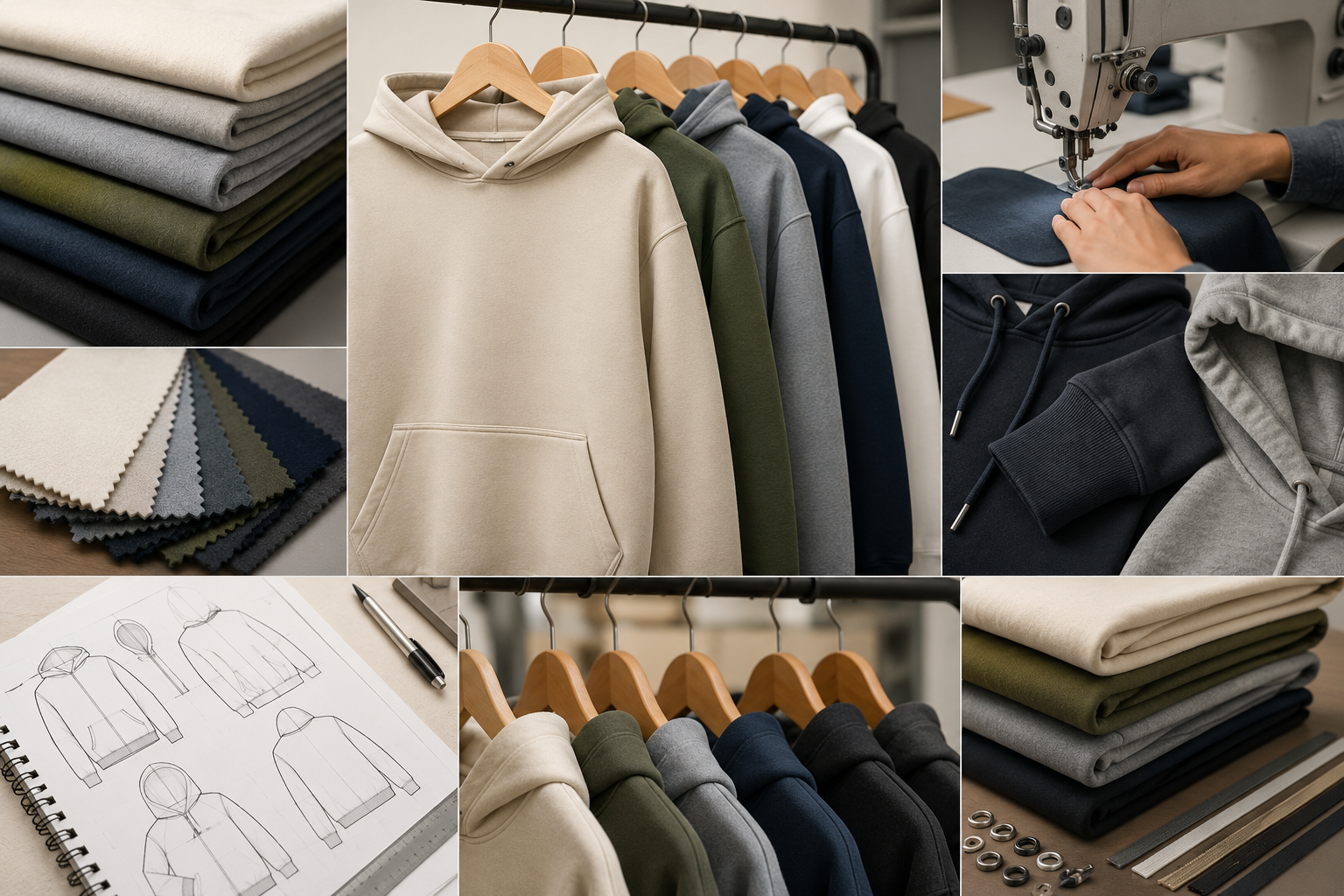
Hoodie Manufacturing Guide: Fabric GSM, Fit & Finishing Options
The right hoodie starts with three decisions: fabric weight (GSM), the fit model that matches your brand, and finishing techniques that balance durability with cost.
GSM (grams per square meter) determines warmth and longevity; fit shapes how your customer base perceives quality and comfort; and finishing stitching, pocket sealing, drawstring reinforcement separates a mass-produced hoodie from one that feels premium.
This guide distills 20+ years of apparel manufacturing into the specifications and workflows that separate the best hoodie manufacturers from the rest. Whether you’re building your first collection or scaling to 10,000+ units, these decisions will define how your hoodie performs in the market.
What Is GSM and Why Does It Matter for Hoodies?
GSM stands for grams per square meter — it’s the weight of fabric per unit area. For hoodies, GSM directly translates to warmth, durability, and customer perception of quality. A 180 GSM hoodie feels lightweight and breathable; a 320 GSM hoodie feels heavy and luxurious; and anything above 400 GSM is reserved for premium winter gear.
The confusion many brands face: more weight doesn’t always mean better. A 280 GSM hoodie with quality dye-lots and tight stitching outsells a 350 GSM hoodie made on older equipment with loose seams. At Curves & Hems, we work with brands to find the sweet spot for their price point, market, and use case.
Why GSM matters:
- Below 200 GSM: Summer hoodies, lightweight travel, thin under-layers. Prone to pilling if fabric quality is poor.
- 200–280 GSM: The standard range. Feels substantial without being heavy. Works for year-round wear, gym use, casual streetwear.
- 280–350 GSM: Premium, winter-weight. Customers perceive this as luxury. Higher production cost; longer drying time post-wash.
- 350+ GSM: Ultra-heavy fleece. Requires reinforced seaming and drawstring stitching. Best for outerwear, work wear, or heritage brands with price-premium positioning.
How Do You Choose the Right GSM for Your Hoodie?
The GSM decision is tied to three factors: brand positioning, target market climate, and production budget.
If you’re a budget-friendly direct-to-consumer brand, 200–220 GSM works. Customers expect lightweight, fast-drying, affordable hoodies. Manufacturers can produce at speed without heavy equipment investment. The risk: pilling and loss of shape after 20–30 washes.
If you’re mid-market (price point $35–60 USD), 240–280 GSM is the standard. This range balances perceived quality, durability, and margin. A 260 GSM hoodie withstands 50+ washes with minimal pilling if the yarn is combed cotton or a quality cotton-poly blend. This is the range most custom hoodie manufacturing companies recommend.
If you’re premium or heritage (price point $80–150+ USD), 300–350 GSM is expected. Your customer base associates weight with durability and luxury. At this weight, fabric choice becomes critical — you’re often sourcing from specialty mills (Ring-spun cotton, Japanese fleece and organic cotton blends). Production timelines extend by 10–15%; so does the price per unit.
Climate matters. Hoodies sold in Southeast Asia or year-round warm climates need 180–220 GSM. Northern markets (Canada, Scandinavia, Eastern Europe) expect 260–300+ GSM. Mixed-climate brands typically produce two weights: a “spring/fall” version (220 GSM) and a “winter” version (280+ GSM).
Production capacity and margin also shape GSM choice. A 180 GSM fleece requires 2–3 production days; a 350 GSM requires 4–5 days. Smaller runs (500–2,000 units) benefit from lighter weights to reduce turnaround. Larger runs (5,000+ units) can absorb the production time for heavier weights and often achieve per-unit cost savings.
What Are the Main Fit Models for Hoodies?
Fit is where customer satisfaction lives or dies. A hoodie with exceptional fabric but poor fit generates returns and negative reviews. A simple fit with confident silhouette builds customer loyalty.
At Curves & Hems, we work with brands on five core fit models:
Regular Fit (Classic/Standard Hoodie)
Best for: Heritage brands, outdoor wear, workwear, mainstream streetwear.
Specs:
- Chest measured 4 inches below armhole, relaxed/laid flat: body width = chest size + 2–4 inches
- Sleeve length: 34–36 inches (size L) — wrist should rest mid-hand
- Body length: 27–29 inches (size L) — hem sits 2–3 inches below hip bone
- Armhole depth: 8–9 inches (allows for full range of motion)
- Shoulder seam drops 1–2 inches past natural shoulder point for comfort
Why it works: Predictable fit for customers who know their size. No surprises. Retail-friendly because it matches department store expectations.
Slim Fit
Best for: Contemporary brands, younger demographics (18–35), athletic/gym wear.
Specs:
- Chest: body width = chest size + 1–2 inches (tapered)
- Sleeve taper: narrows from armhole to cuff; wrist opening 6.5–7 inches
- Body length: same or 0.5 inches shorter than regular (27–28 inches for size L)
- Shoulder: normal drop (same as regular) but narrower chest = visual slimming
- Rib finish: tighter (1×1 or 2×2 rib) to hug the arm
Fit challenge: Slim fit alienates customers with athletic or larger builds. Best paired with size-inclusive ranges (XS–3XL) to show inclusivity.
Oversized/Boxy Fit
Best for: Luxury/designer brands, Gen-Z streetwear, unisex/genderless collections.
Specs:
- Chest: body width = chest size + 5–8 inches (intentionally roomy)
- Sleeve: relaxed, hits wrist or mid-hand with generous room through bicep
- Body length: 29–32 inches (size L) — hem sits mid-hip or longer
- Shoulder: drops 2–3 inches past natural shoulder (exaggerated for intentional slouch)
- Cuff/hem: usually oversized rib (1×1) that sits loosely
Market fit: Oversized is now the dominant trend in streetwear and luxury. Brands charging $90–$200 position oversized as intentional design, not sizing error. Requires confident brand voice to justify.
Cropped Fit
Best for: Women’s collections, youth/teen wear, fashion-forward brands.
Specs:
- Chest: standard (chest size + 2–3 inches)
- Body length: 22–25 inches (size M) — hits above hip, shows waistline
- Sleeve: normal length
- Hem/cuff: often a ribbed band that creates visual finish at shorter length
Sizing note: Cropped fit works for sizes XS–L. Sizing beyond L requires careful sample approval proportions become off-balance.
Unisex/Gender-Neutral Fit
Best for: Inclusive brands, workwear, casual athletic.
Specs:
- Chest: middle ground between regular and oversized (chest size + 3–3.5 inches)
- Length: mid-hip (27.5–28 inches for size M) — neutral between male and female proportions
- Shoulder: minimal drop (0.5–1 inch) — fits broader shoulders without excess
- Sleeve: straight, no excessive taper
- Waistline: no dart or princess seam — allows all body types to wear comfortably
Why unisex works: Unisex sizing simplifies inventory and appeals to non-binary customers. One size chart instead of separate men’s/women’s grading.
How Do You Finalize a Fit? The Sampling Process
Fit approval is non-negotiable. At Curves & Hems, the process is:
- Tech pack review: Brand provides measurements, design specs, and visual references. We confirm baseline specs.
- First sample (S1): Produced in target GSM and colorway. Fit feedback required within 7 days. Common fixes: sleeve length, chest width, hem length.
- Second sample (S2): Revisions applied (usually 1–3 fit adjustments). Final approval or minor tweaks.
- Sample for production approval: Approved fit sample sent to production team as reference garment (physical standard). Production samples any future unit against this reference.
Brands that skip sampling often regret it. A 1-inch difference in sleeve length or chest width cascades across 5,000 units. Sampling costs $40–$80 per garment; bulk production mistakes cost $5,000–$25,000+.
What Finishing Options Separate Premium from Standard Hoodies?
Finishing is the craft layer. Fabric and fit are the foundation; finishing is what customers feel and talk about.
Stitching
Single-needle stitching (standard): One thread runs top and bottom. Fast, cost-effective. Fine for budget hoodies (180–220 GSM). Visible on seams; looks standard.
Double-needle stitching (premium): Two parallel threads run the same seam. Stronger, more durable, visible aesthetic. Costs 10–15% more per unit but justifies premium positioning. Standard for 260+ GSM hoodies.
Flat-lock stitching (specialist): Used on side seams and shoulder seams. Eliminates bulk and irritation. Premium brands (100%+ price premium vs. basic) use this. Requires trained operators.
Contrast stitching (designer/custom): Thread color contrasts with fabric. Adds $0.30–$0.50 per garment but creates perceived luxury. High-street fashion brands use this heavily.
Drawstrings
Basic (low-cost): Single-ply cotton twill, 4–5 mm thick. Standard length 130–150 cm. Prone to fraying at ends and sliding out during wash.
Reinforced (mid-market): Double-ply or poly-blend, 6 mm thick. Sewn into casing (hood opening) at two points (top and sides). Prevents sliding. Ends heat-sealed or folded and stitched.
Premium (luxury): Japanese woven drawstring (sometimes branded with company logo), aglet ends (metal caps), or leather-tipped drawstrings. 8+ mm thick. Costs $0.80–$1.50 per pair but conveys craftsmanship.
Flat drawstring vs. round drawstring: Flat (ribbon-like) is trendy and contemporary; round is traditional. Flat is slightly cheaper to produce; round feels more premium but can slip.
Pocket Construction
Basic (budget): Single-ply fabric, single seam. Prone to tearing under stress. No reinforcement at corners.
Reinforced corners: Double-stitching at top corners of pocket opening prevents tearing. Adds $0.15 per unit.
Boxed pockets (premium): Reinforced stitching all around pocket opening and a deeper pocket depth (5–6 inches). Requires precision and strong operators. Adds $0.40–$0.60 per garment.
Hand-finished pockets (luxury only): Rare. Pockets are hand-stitched or topstitched with contrast thread for visual and tactile luxury. Costs $1–$2 per unit; used only on $150+ hoodies.
Hood Construction
Basic (budget): Single-layer hood, single seam where hood meets body. No reinforcement. Prone to puckering or tearing.
Reinforced hood (standard): Double-stitching where hood attaches to body. Hood itself may be slightly padded (thin foam) for shape retention.
Eyeleted hood (premium): Metal eyelets on hood corners (where drawstring exits) prevent wear and add visual detail. Costs $0.20–$0.30 per unit.
Structured hood (luxury): Hood is interfaced (stiffened with fusible material) to hold shape even when hood is down. Creates polished silhouette. Requires specialty mills.
Hem and Cuff Finishing
Cut-and-sew (budget): Fabric hemmed with single-needle; may curl or fray after 10+ washes.
Ribbed cuffs/hem (standard): 1×1 or 2×2 rib knit sewn and folded. Creates finished edge that doesn’t fray. Standard for 200+ GSM.
Contrast-color rib (design choice): Rib in different color than body. Adds $0.15–$0.30 per unit. Creates contemporary look.
Folded and topstitched hem (premium): Hem is folded and topstitched with contrast or matching thread. Visible detail; requires precision. Adds $0.25–$0.40 per unit.
What Does Curves & Hems Bring to Hoodie Manufacturing?
As a custom hoodie manufacturing company based in Ajmer, Rajasthan, we handle every stage:
- Fabric sourcing: Direct partnerships with mills in Gujarat and imports from specialty fleece mills (Japan, Korea, India). We match your GSM spec to budget and quality tier.
- Pattern grading: Consistent fit across XS–4XL using validated grading rules (incremental changes per size, no proportional errors).
- Sample production: First, second, and approval samples in 7–10 days. Full fit feedback on each.
- Production setup: Once approved, your sample becomes the reference garment. Every bulk unit is quality-checked against it.
- Finishing accuracy: Double-needle stitching, reinforced pockets, eyeleted hoods, and contrast elements handled in-house or via vetted partners.
- Doorstep delivery: Boxes ship to your location with full documentation, care labels, and hang-tags ready.
Frequently Asked Questions
What GSM should I choose for my first hoodie collection? Start with 240–260 GSM if you’re going 100% cotton or cotton-blend. This weight is the industry standard, and customers recognize it as quality without the premium price tag of 300+ GSM. If you’re underselling competitors at $40–$50, go 220 GSM to protect margin. If you’re premium-positioned ($70+), go 300+.
Can I make a hoodie in multiple GSM weights? Yes, and we recommend it. Launch with one core weight (e.g., 260 GSM in “Original” or “Classic”), then add a lightweight version (220 GSM in “Summer”) or heavy version (320 GSM in “Winter”) after your first 2,000 units sell. This keeps initial inventory lean and lets you test market demand by weight.
How many samples do I need before production? Minimum two. First sample to identify fit issues; second to confirm fixes. If you’re designing a unique hoodie (oversized with cropped sleeves, custom hoods, etc.), request three samples. Each sample iteration costs $50–$80 but prevents bulk production mistakes that cost 100x more.
What’s the difference between fleece and french terry? Fleece is brushed on both sides, creating a soft interior and exterior. French terry is brushed only on one side (interior); the exterior shows the loop structure. Fleece feels luxurious and warm but pills more easily if low-quality. French terry is more durable and has a contemporary, structured look. For hoodies, 100% fleece is standard; french terry is less common but used by contemporary brands.
Why do some hoodies pill after a few washes? Pilling happens when short fibers (staples) work loose during abrasion. Low-GSM hoodies (under 200 GSM) with short-staple fiber pill readily. Combed cotton and long-staple fiber resist pilling. If budget is tight, a 220 GSM with combed cotton defeats a 280 GSM with short-staple fiber in durability tests.
How much does finishing add to the unit cost?
- Contrast stitching: +$0.15–$0.25
- Reinforced drawstring: +$0.30–$0.50
- Boxed pockets: +$0.40–$0.60
- Eyeleted hood: +$0.20–$0.30
- Topstitched hem: +$0.25–$0.40
Layering three finishing upgrades costs an extra $0.90–$1.50 per unit but justifies a $10–$20 price increase at retail.
What’s the minimum order quantity for custom hoodies? Most manufacturers, including Curves & Hems, have a MOQ of 500–1,000 units per color and size mix. This allows for efficient production scheduling and reasonable sample investment. If you need lower quantities, expect a 15–25% upcharge per unit.
How long does production take for 5,000 hoodies? Standard timeline: 4–5 weeks from sample approval to shipment. This includes fabric receipt, cutting, sewing, quality checks, and packing. Rush orders (2–3 weeks) incur a 10–15% upcharge. Lead times extend if you’re using specialty fabrics or complex finishes (embroidery, screen printing, woven labels).
Should I order in bulk for my first collection? Not necessarily. Many brands start with 1,000–2,000 units (multiple colors and sizes combined), test market response over 8–12 weeks, then scale to 5,000+ units once sell-through validates the fit and positioning. This de-risks inventory and capital.
Leave a Reply