

T-Shirt Manufacturing in India: Fabrics, GSM, MOQ & Production Process
The t-shirt looks like the simplest garment in any brand’s line sheet — until you’re the one sourcing it. Get the fabric wrong and it pills after three washes. Get the GSM wrong and it either feels cheap or overheats the customer. Get the MOQ wrong and you’re either sitting on stock or begging a factory to run a quantity they don’t want to touch. After decades of watching brands get burned on exactly these three variables, this guide breaks down what actually matters when you’re sourcing t-shirt manufacturing in India — not the marketing version, the working version.
Why India Is a Default Choice for T-Shirt Manufacturing
India produces more cotton than almost any country on earth, and its knitwear clusters — Tirupur above all — have spent forty years doing nothing but perfecting t-shirt production at scale. That combination of raw material access and specialised labour is why so much of the world’s basic and mid-range t-shirt supply quietly runs through Indian factories, UK and US private label brands included.
T-Shirt Fabrics: What You’re Actually Choosing Between
Fabric choice is the single biggest lever on cost, feel, and durability. Here’s what shows up on most tech packs:
- 100% Cotton (Combed/Carded) — Combed cotton has had short fibres removed before spinning, giving a smoother, more premium hand-feel and fewer imperfections. Carded cotton is cheaper and slightly coarser — fine for basics, less fine for premium ranges.
- Ring-Spun Cotton — Spun using a process that twists and thins fibre strands more finely, producing a softer, stronger yarn than standard open-end cotton. This is what most “premium tee” brands are actually paying for.
- Cotton-Polyester Blends (CVC/Poly-Cotton) — Common blends are 60/40 or 50/50 cotton-poly. They reduce shrinkage, improve colour retention, and lower cost, at some expense to breathability.
- Organic Cotton — GOTS-certified organic cotton costs more but is increasingly demanded by UK and EU brands for sustainability positioning.
- Bamboo and Modal Blends — Used for a softer, more fluid drape in premium and loungewear-adjacent tee ranges.
- Slub Cotton — Deliberately irregular yarn thickness for a textured, vintage-look fabric, popular in fashion-forward and streetwear lines.
GSM Explained: The Number That Decides How Your T-Shirt Feels
GSM (grams per square metre) measures fabric weight and density. It’s one of the most searched and least understood specs in apparel sourcing, so here’s the practical breakdown:
- 120–150 GSM — Lightweight, summer-weight tees. Common in fast fashion and hot-climate markets. Feels thin; less structure.
- 160–180 GSM — The most common range for everyday retail t-shirts. Balances breathability with enough substance to hold shape.
- 180–200 GSM — Mid-heavy weight, often used by premium basics brands (the “feels expensive” range). Better drape, less see-through.
- 200–220 GSM — Heavyweight tees, streetwear and boxy-fit styles. Strong structure, holds oversized silhouettes well.
- 220+ GSM — Used for heavyweight streetwear, structured drop-shoulder tees, and premium fashion pieces where weight itself is a selling point.
A GSM figure means nothing on its own — a 180 GSM combed ring-spun cotton and a 180 GSM standard carded cotton will feel noticeably different on the body. Always request a physical swatch at your target GSM before locking specs, not just a number on a spec sheet.
MOQ for T-Shirt Manufacturing in India: What to Actually Expect
Minimum order quantities are the most negotiated line item in any sourcing conversation, and they vary by manufacturing model:
- Standard factory MOQ: 300–500 pieces per style/colour is typical across most Tirupur and Delhi NCR knitwear units.
- Low-MOQ private label programmes: Increasingly, manufacturers offer 100–250 piece MOQs for brands testing new styles, though usually at a higher per-unit cost.
- Per colourway vs per style: Clarify whether the MOQ applies per colour or across the whole style — this changes total unit economics significantly if you want to launch in three colourways.
- Blank vs. printed/embroidered MOQs: Screen printing and embroidery often carry their own separate minimums on top of the base garment MOQ, since set-up costs are fixed regardless of run size.
Smaller MOQs are achievable, but expect a trade-off in either price per unit or fabric/colour flexibility — no factory absorbs the cost of a short run for free.
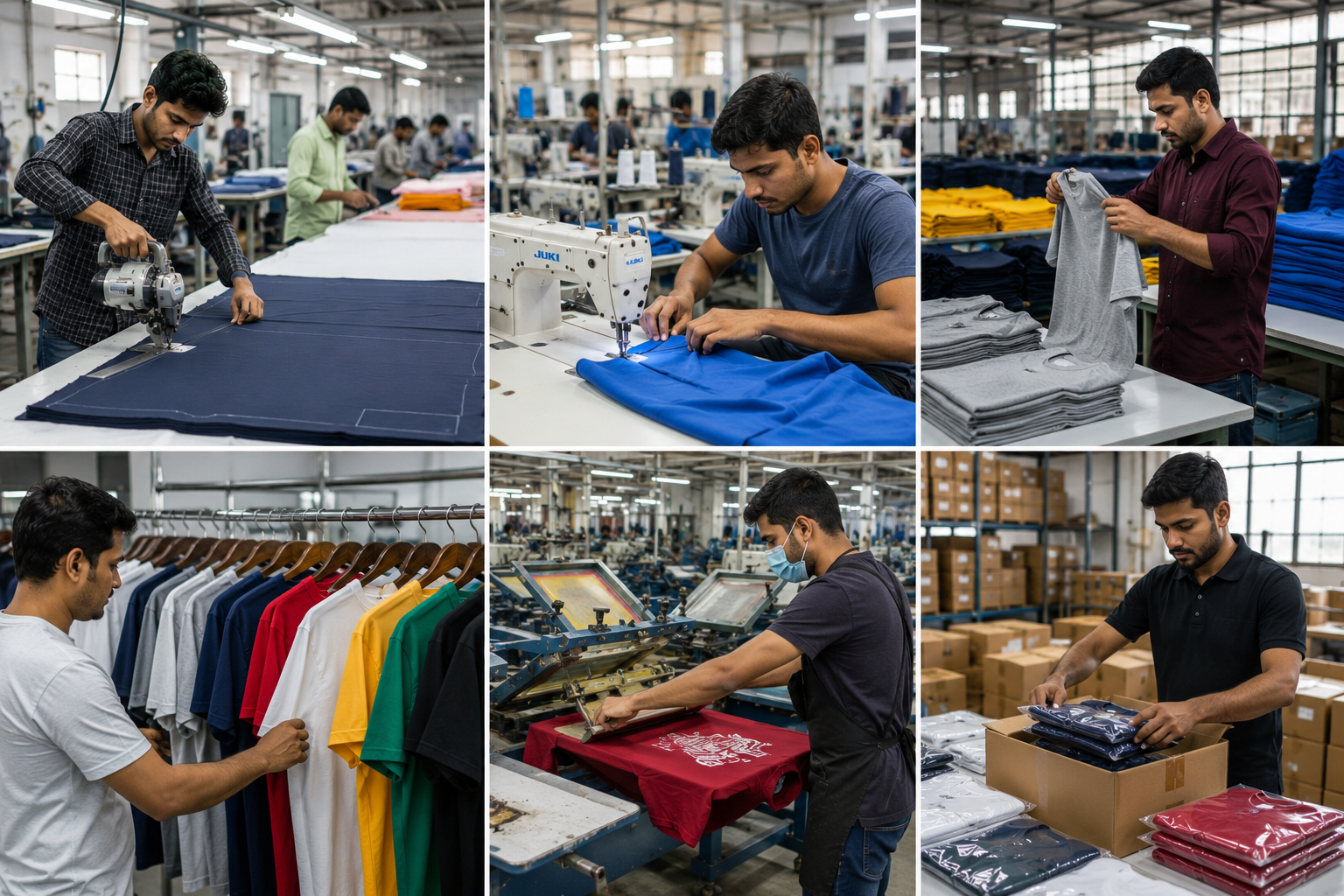
The T-Shirt Production Process, Step by Step
- Tech pack and sampling — You supply (or the factory develops) a tech pack specifying fabric, GSM, fit, measurements, and trims. A proto sample is produced for approval, typically within 1–3 weeks.
- Fabric sourcing and knitting — Yarn is sourced and knit into fabric rolls at the specified GSM. This is where GSM tolerance (usually ±5%) is set and tested.
- Fabric processing — Dyeing, washing, and compacting (pre-shrinking) happen here. Compacting matters enormously for post-wash shrinkage control — ask about it directly if your tech pack has strict shrinkage tolerances.
- Cutting — Fabric is laid and cut according to graded pattern pieces across your size run.
- Sewing and construction — Panels are stitched together; this includes shoulder taping, collar/rib attachment, and hemming. Stitch quality and seam type (e.g., flatlock vs. overlock) affect both durability and finish.
- Printing/embroidery (if applicable) — Screen printing, DTG, or embroidery is applied at this stage, before or after garment construction depending on technique.
- Quality control (QC) — Inline QC checks happen during production; a final AQL (Acceptable Quality Limit) inspection is done before packing, checking stitching, measurements, colour consistency, and print/embroidery placement.
- Finishing and packing — Trimming loose threads, ironing/pressing, folding, tagging, and poly-bagging per your packing list specifications.
- Export documentation and shipping — Commercial invoice, packing list, and certificates of origin are prepared for UK-bound freight, whether by sea or air.
Common Mistakes UK Brands Make on T-Shirt Specs
- Specifying a GSM without specifying yarn type — the same GSM can produce very different hand-feel
- Not requesting a wash-test sample to check shrinkage before bulk production
- Assuming MOQ applies to the whole order rather than per colour or per size-set
- Skipping a pre-shipment inspection on a first order, especially for print-heavy styles where placement errors are common
Frequently Asked Questions
What GSM is best for a premium basic t-shirt? Most premium basics brands land between 180–200 GSM using combed, ring-spun cotton, which gives structure and a substantial feel without becoming heavyweight streetwear territory.
What is a typical MOQ for t-shirt manufacturing in India? Standard MOQs range from 300–500 pieces per style/colour, though some manufacturers offer 100–250 piece options for new or testing brands, usually at a higher unit cost.
Is 100% cotton better than a cotton-polyester blend for t-shirts? Neither is universally “better” — 100% cotton offers superior breathability and a natural feel, while cotton-poly blends resist shrinkage and hold colour longer, making the right choice dependent on your product positioning and price point.
How long does t-shirt sampling take with an Indian manufacturer? Most factories deliver an approved proto sample within 1–3 weeks, depending on fabric availability and design complexity.
T-shirt manufacturing looks simple from the outside, but fabric composition, GSM, and MOQ are the three variables that quietly decide your margin, your fit consistency, and your customer’s first impression of quality. Nailing the spec conversation with your manufacturer before production — not after the first shipment lands — is what separates brands that scale smoothly from brands that spend a year firefighting quality complaints.
At Curves & Hems, this spec-first approach is exactly how t-shirt programmes are built for UK and international brands — from fabric and GSM selection through sampling, production, and export. If you’re sourcing t-shirts and want a manufacturing partner who gets the details right the first time, get in touch with Curves & Hems to discuss your next collection.

Leave a Reply